
31 Jan 2012 4
The Cheese Diary: January 2012
Living in a country that boasts more variety of cheese than the number of days in a year, I really should take advantage of my good fortune and be better acquainted with the selection available at the local fromageries. Random taste-testing seems to be the way to go. I could possibly try a cheesy Project 365 but I fear what it will do to my svelte* (ahem) silhouette, not to mention my bank balance. Let’s just go with one a week and I’ll try to do a round-up every month in this quest of mine to be a turophile.

Week 1: Moelleux du Revard
Produced in the Savoie region (Mont Revard, hence the name) since 2008 (yes, this is a rather young production), this solid but soft cheese is made from raw cow milk, refined over a period of minimum 5 weeks. I bought just a small sliver from what’s normally a cheese in disc shape with orange-coloured washed-rind. It cut easily to reveal an ivory centre with some small eyes (i.e. the holes in cheeses). Its texture is creamy while its taste is rather mild. Not sure if this would be very memorable after a couple of weeks.
Week 2: Raclette
Raclette is no mere cheese, it makes a meal to be shared among friends. I was introduced to the joy of raclette by Chloé a few years ago, and it is one of the few perfect cheesy winter dish, melted over a plateful of boiled potatoes, charcuterie and some salads. A semi-firm cheese, a whole raclette is a large wheel of cheese of pale cream colour. As Chloé owns a proper raclette grill, a wedge of the wheel was duly purchased (about 200g per person) and mounted to the grille. The heating grill was then lowered close to the surface of the raclette, melting it and then scraped onto the plates. I love the slightly burnt rind – crunchy and caramelised – and the cheese itself is not for the faint-hearted when you see the amount of grease dripping down during the melting process. Everyone at the table takes turn to slid their plates under the grill, with chatters and laughter aplenty. Gimme more cold days for raclette please!
Week 3: P’tit Basque
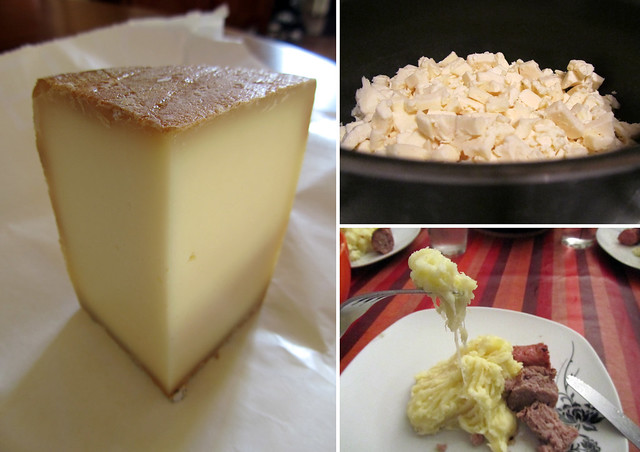
A modern cheese (introduced in 1997), P’tit Basque is made from pasteurised sheep milk and aged over a period of 70 days. As the name implied, it is small in size and came from the Basque region (of France though, not Spain). The cheese has a smooth paste in pale cream without any eyes, enveloped by light brown rind. The cheese is quite firm to touch, but remains relatively soft and moist in texture. Creamy even. It is not particularly pungent and instead, mild to taste but with a hint of sweetness (akin to caramelised sugar which I’ve taken a real liking to) blending with saltiness. I’d quite happily eat more of these.
Week 4: Tomme fraîche / Aligot
Yet another winter favourite, aligot is a dish made using the cheese tomme fraîche although you could easily tell the cheesemonger you’re looking for aligot and s/he would know what you want anyway. Tomme fraîche often comes in big block which is then cut according to quantity required. It resembles feta at first glance, white in colour and without rind. It is also elastic to touch. To prepare aligot, the cheese is melted down while potatoes are boiled and mashed. They are then combined together with some butter and chopped garlic, which properly done would produced smooth and cheesy mash that can be pulled into long strings. Happy days. Serve with some good hearty (Toulouse) sausages, the mild and creamy mash pulls the flavour in together beautifully.
* Honestly, I have a slight built but not all that svelte – can anyone tell how much weight I’m putting this winter from all these decadent eating yet? ;) Good thing I have eating partners in crime. Hurrah for friends who do love their cheeses and willing to indulge me in my whims!